


Painting Cosmos Flowers
Drawing in perspective & creating a final composition

-
Drawing flowers from different angles (front-facing, side view, buds)
-
Understanding perspective before painting
-
Keeping things loose, light and flowing
-
Building a balanced final composition
Cosmos are perfect for watercolour – they’re airy, elegant and forgiving. We’re aiming for movement and suggestion, not perfection.
Materials
-
Watercolour paper (cold-pressed)
-
Round brush (size 6–10)
-
Pencil & eraser
-
Water jar & kitchen roll
-
Cocktail stick
Colours (suggested)
-
Pink / Rose / Opera Pink
-
Crimson or Alizarin Crimson
-
Yellow - warm
-
Sap Green
-
Ultramarine Blue or sepia
-
Paynes Grey
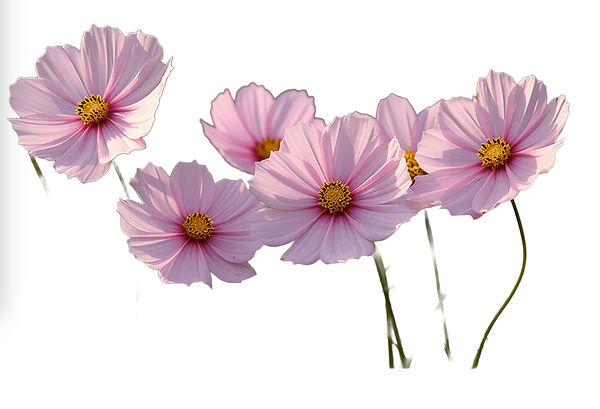
Step 1: Observing cosmos (perspective)
Before drawing, notice how cosmos change depending on angle:
-
Front-facing flowers
Open and flat, with petals radiating around a circular centre. -
Three-quarter / side view
Petals overlap, the centre becomes an oval or may be hidden. -
Buds
Simple teardrop shapes with a hint of colour at the tip.
Think in shapes, not individual petals.

Step 2: Drawing practice (warm-up)
Use light, sketchy pencil lines.
-
Start with a circle or oval for the centre:
-
Circle = facing us
-
Oval = turned away
-
-
Add petals as elongated oval shapes radiating out.
-
Vary:
-
Size
-
Spacing
-
Overlap
-
-
For side-facing flowers
-
Draw a soft cup or cone shape
-
Add just a few visible petals wrapping around the form
Don’t aim for symmetry – wonky is good.
Step 3: Stems & movement
-
Draw long, gentle S-shaped stems
-
Let flowers face different directions
-
Allow stems to cross occasionally
Cosmos should feel tall, floaty and relaxed.
Step 4: Painting the petals (first wash)
-
Paint each petal one by one. As any paint you put down will bleed into any adjacent wet or damp areas on the page, you will need to paint alternate petals. This will give the first set of petals a chance to dry
-
Have two brushes handy, one for paint and one damp with clear water
-
Mix some medium strength pink colour
-
Place it at the root of the petal, near the centre
-
switch to your damp brush and use this to encourage your paint to bleed gently to the top of the petal. We're aiming for the petals to be dark near the flower's centre and lighter as they get to the edge
-
before the paint dries, use your cocktail stick to draw curves along the petal to help show the form.
-
Follow the direction of the petal, especially on side views.
Leave white gaps between petals – this keeps the flower light.
Step 5: Adding depth (while damp)
-
Drop in a slightly stronger pink or crimson:
-
Near the centre
-
Where petals overlap
-
Let the paint bloom naturally. Don’t fiddle.
For side-facing flowers:
-
Keep far petals lighter
-
Slightly stronger colour on the nearer edge

Step 6: Painting the centres
-
Mix yellow with a tiny touch of crimson to get a yellow-orange colour
-
Dab loosely or use the other end of your paintbrush to make dots – avoid a perfect circle
-
While damp, add darker specks of sepia or brown (above orange mixed with a little ultra marine blue) for texture
Step 7: Stems & foliage
-
Mix sap green with a tiny amount of alizarin or pink to desaturate it slightly
-
Using a liner brush, paint stems in one confident stroke
For foliage:
-
Use quick, flicky marks
-
Vary pressure and direction
-
Keep it airy – less is more
Add a touch of ultramarine or crimson to the green for shadow once dry.
Step 8: Creating the final composition
Aim for:
-
Odd numbers of flowers
-
A mix of:
-
One main bloom
-
One or two side-facing flowers
-
A bud
-
-
Plenty of white space
If something feels too heavy, stop. Cosmos look best when they feel slightly unfinished.
Helpful reminders
-
Start pale – you can always add more
-
One confident stroke beats lots of small ones
-
If it looks a bit wonky at the drawing stage, you’re doing it right
Enjoy the looseness and let the flowers do their thing 🌸
Book Your Spot

Starts Sep 5
From 40 British poundsLoading availability...
Loading availability...

Starts Sep 9
From 20 British poundsLoading availability...
Loading availability...

Starts Sep 15
125 British poundsLoading availability...
Loading availability...

Starts Sep 16
From 104.17 British poundsLoading availability...
Loading availability...

Starts Sep 19
From 115 British poundsLoading availability...
Loading availability...

Ended
105 British pounds